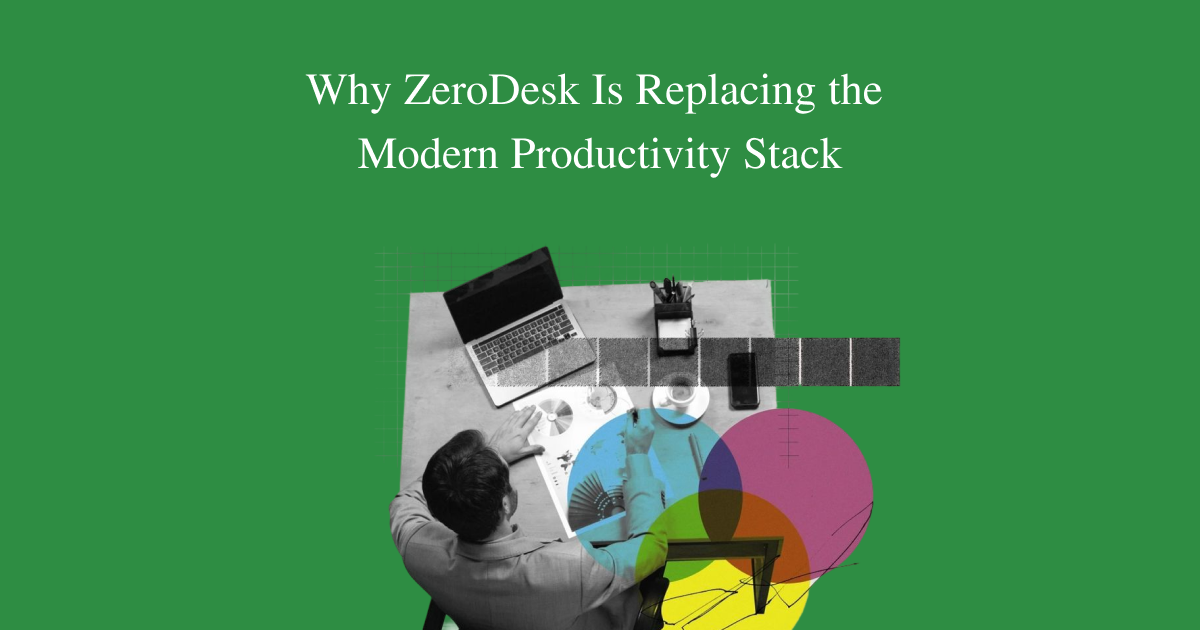
Why ZeroDesk Is Replacing the Modern Productivity Stack
Introduction
The modern workplace is buried under software that was supposed to make work easier.
The Typical Productivity Stack
- Slack for communication
- Notion for documentation
- ClickUp for tasks
- A document hub for working materials
- Zapier for automation
- ChatGPT for AI
- CRM tools for sales
- Analytics tools for reporting
Most companies today operate inside a maze of disconnected systems.
And somehow, despite having more productivity software than ever before, teams still feel overwhelmed, slower than expected, and constantly operationally overloaded.
That is because the modern productivity stack was never designed to eliminate work.
It was designed to manage fragmented work.
And that is exactly why ZeroDesk believes AI-native workspaces will eventually replace large portions of today's SaaS ecosystem.
The Software Industry Normalized Fragmentation
For years, SaaS companies convinced businesses that every workflow required a separate tool.
The SaaS Playbook
- One product for communication
- One for documentation
- One for project management
- One for analytics
- One for presentations
- One for workflow automation
- One for research
Every operational problem became another software category.
And companies accepted this because there was no alternative.
The Hidden Cost
The result is that most employees now spend huge portions of their day:
- Switching tabs
- Searching for information
- Rewriting updates
- Moving data between systems
- Managing dashboards
- Coordinating fragmented workflows
The software itself became operational overhead.
That is the hidden problem AI-native systems are starting to expose.
Productivity Software Often Creates More Work Than It Removes
This is the uncomfortable truth many businesses are quietly realizing.
Most modern productivity tools optimize management, not execution.
What Employees Actually Spend Time Doing
- Tracking workflows
- Updating statuses
- Maintaining systems
- Organizing information
- Coordinating communication
- Managing operational complexity
Very little of this activity directly creates value.
But traditional software depends on humans manually maintaining workflows because the systems themselves lack intelligence.
That is why so many companies still feel operationally inefficient despite spending enormous amounts of money on productivity software.
The tools became more advanced.
The workflows stayed fragmented.
ChatGPT and Claude Changed Expectations Overnight
Once GPT and Claude entered the workplace, users suddenly experienced something radically different.
AI Could Instantly
- Write content
- Summarize information
- Analyze documents
- Conduct research
- Generate ideas
- Reason through complex problems
That shift permanently changed expectations around how software should behave.
Because once people experienced AI-powered speed, traditional productivity workflows immediately started feeling outdated.
Naturally, the next question followed:
If AI can generate work this quickly, why are humans still manually coordinating fragmented systems all day?
That question is becoming increasingly dangerous for traditional SaaS companies.
AI-Native Workspaces Challenge the Entire SaaS Operating Model
This is why AI-native systems represent a much larger disruption than most businesses currently realize.
Traditional SaaS survives because workflows are fragmented.
Different companies own different layers of operational work.
But AI-native workspaces collapse multiple workflows into one intelligent environment.
Instead of Managing Separate Systems For
- Research
- Presentations
- Analysis
- Workflow automation
- Task management
- Documentation
- Communication
AI-native systems can increasingly handle large portions of those workflows directly.
That dramatically reduces operational complexity.
And over time, it may significantly reduce the need for fragmented software stacks altogether.
ZeroDesk Is Betting Against Software Sprawl
Most productivity companies are trying to survive the AI transition by adding AI features onto existing products.
ZeroDesk is approaching the future differently.
Instead of building another SaaS tool inside the existing ecosystem, it is betting that the ecosystem itself is becoming obsolete.
The ZeroDesk Approach
Inside one integrated workspace:
- Research happens automatically
- Workflows coordinate intelligently
- Information organizes itself
- Execution accelerates natively
- Operational friction decreases dramatically
The goal is not helping companies manage fragmented workflows more efficiently.
The goal is reducing fragmentation itself.
That is a completely different product philosophy from traditional productivity software.
AI Agents Are Accelerating the Collapse of Fragmented Workflows
The rise of AI agents makes this shift even more disruptive.
Because once AI systems become capable of:
- Conducting workflows
- Organizing operations
- Executing tasks
- Synthesizing information
- Managing coordination
Many existing SaaS categories become vulnerable simultaneously.
What One AI-Native Workspace Can Potentially Replace
- Research tools
- Automation platforms
- Presentation software
- Knowledge management systems
- Workflow tools
- Reporting layers
All inside one environment.
That is why so many software companies are aggressively repositioning themselves around AI right now.
They understand the threat.
The challenge is that many are still built on fragmented workflow models underneath the AI branding.
The Future Belongs to Companies With Less Operational Drag
Most organizations today still operate like managers of software systems.
Employees spend large portions of their day maintaining workflows instead of driving execution.
AI-native companies will increasingly operate differently.
What Changes
- Smaller teams move faster
- Operational overhead shrinks
- Decision-making accelerates
- Research becomes autonomous
- Execution becomes more intelligent
The businesses that adapt to AI-native productivity early may gain significant advantages over competitors still buried under fragmented app stacks and manual coordination.
And over time, that speed difference compounds.
The Next Generation of Software Will Feel Fundamentally Different
The future of productivity is not:
More Of This
- More dashboards
- More tabs
- More tools
- More notifications
- More workflow management
It Is This Instead
- Fewer systems
- More intelligence
- More automation
- More execution
- Less coordination
That is the transition happening right now across enterprise software.
Businesses are beginning to realize they do not simply need better tools anymore.
They need a different operational model entirely.
Why ZeroDesk Believes the Productivity Stack Is Disappearing
The productivity stack exists because software historically lacked intelligence.
Humans acted as the bridge between disconnected systems.
They moved information, coordinated workflows, and maintained operational processes manually.
AI changes that relationship.
When software can understand context, conduct research, automate workflows, organize information, and execute tasks, the need for large collections of disconnected tools begins to shrink.
That is the shift ZeroDesk is betting on.
Final Thoughts
The modern productivity stack exists because software historically could not think, analyze, organize, or execute independently.
Humans had to coordinate everything manually.
AI changes that completely.
What Changed
- GPT changed software expectations
- Claude improved reasoning
- AI agents accelerated execution
- AI-native workspaces are challenging the fragmented SaaS model
The future is not another productivity tool.
The future is dramatically less operational complexity.
Less software sprawl.
Less workflow maintenance.
More intelligence.
More automation.
More execution.
That is the future ZeroDesk is building toward.