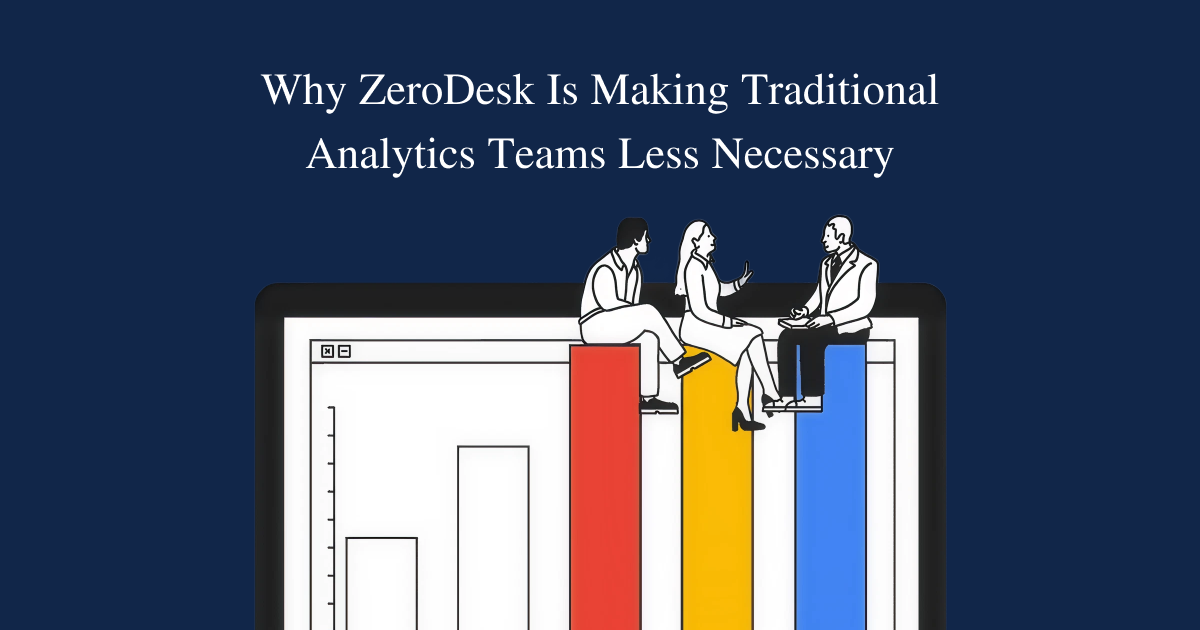
Why ZeroDesk Is Making Traditional Analytics Teams Less Necessary
Introduction
Most companies are sitting on data they still cannot actually use.
Modern businesses collect enormous amounts of information every day.
Data Is Everywhere
- Sales data
- Marketing reports
- Customer insights
- Operational metrics
- Financial dashboards
- CRM activity
- Performance tracking
But despite having more data than ever before, most teams still struggle to get simple answers quickly.
And that is because traditional data workflows were built for a world before AI-native systems existed.
The Traditional Analytics Process
Employees still:
- Export spreadsheets
- Wait for analysts
- Build dashboards manually
- Write SQL queries
- Coordinate reporting teams
- Search through fragmented tools
- Request insights across departments
The process is slow, fragmented, and heavily dependent on technical bottlenecks.
That is exactly why ZeroDesk believes AI-native data exploration is about to fundamentally change how companies interact with information.
Most Businesses Do Not Actually Need More Dashboards
This is one of the biggest misconceptions in modern analytics.
Companies think their problem is a lack of visibility.
In reality, the problem is operational friction.
Most employees are not data analysts.
They are:
- Marketers
- Sales teams
- Founders
- Operators
- Consultants
- Recruiters
- Managers
And they simply need fast answers from data.
But traditional analytics systems force non-technical teams through complicated workflows just to extract basic insights.
The Hidden Dependency Problem
This creates enormous reliance on:
- Data analysts
- BI teams
- SQL specialists
- Reporting operations
- Dashboard maintenance
The result is that companies move slower because information access itself became operationally expensive.
Traditional Analytics Workflows Are Filled With Unnecessary Overhead
Most data workflows today involve multiple layers of coordination.
A Typical Analytics Request
- A team asks a question
- Someone submits a request
- An analyst pulls the data
- Dashboards get updated
- Reports get generated
- Meetings happen around interpretation
Even simple questions can take hours or days to answer.
And once AI entered enterprise workflows, that inefficiency became impossible to ignore.
What AI Can Already Do
- Analyze data instantly
- Summarize trends
- Identify patterns
- Generate reports
- Surface insights
- Answer natural-language questions
Without requiring heavy technical coordination.
That changes the economics of analytics completely.
ChatGPT and Claude Changed Expectations Around Information Access
ChatGPT normalized conversational interaction with information.
Claude improved reasoning and long-context analysis.
Suddenly, users realized software could interact with complex information naturally instead of requiring technical workflows.
And naturally, the next question followed:
If AI can understand documents, research, workflows, and conversations, why should employees still need technical teams for basic data exploration?
That question is becoming one of the biggest disruptions happening inside enterprise analytics right now.
Because most business users do not actually want dashboards.
They want answers.
ZeroDesk Is Betting on AI-Native Data Exploration
Most analytics platforms still revolve around dashboards, reporting layers, and technical dependencies.
ZeroDesk is approaching the problem differently.
Instead of forcing users to navigate fragmented analytics systems manually, AI-native workspaces aim to make data interaction conversational, intelligent, and operationally simple.
What AI-Native Analytics Looks Like
Teams can increasingly:
- Explore datasets naturally
- Analyze trends instantly
- Generate reports automatically
- Surface insights quickly
- Connect analysis directly to execution
All inside one workspace.
The difference is enormous.
Traditional analytics tools store and display information.
AI-native systems help operationalize information.
Most Enterprise Data Problems Are Workflow Problems
Companies often assume their biggest challenge is collecting more data.
But most organizations already collect more than enough information.
The real challenges are:
- Fragmentation
- Accessibility
- Coordination overhead
- Technical bottlenecks
- Slow execution
Employees constantly move between:
- Spreadsheets
- BI tools
- CRMs
- Dashboards
- Reports
- Data warehouses
Trying to piece information together manually.
AI-native workspaces reduce that operational complexity by collapsing workflows into one intelligent environment.
That is where enterprise productivity starts changing dramatically.
AI-Native Analytics Threatens Traditional BI Software
The traditional business intelligence industry depends heavily on complexity.
Traditional BI Relies On
- Dashboards
- Reporting pipelines
- Technical workflows
- Analyst dependencies
- Manual maintenance
AI-native systems threaten that model because they dramatically reduce the amount of technical coordination required to interact with information.
What Intelligent Systems Can Do Instead
- Surface insights automatically
- Generate summaries instantly
- Answer analytical questions naturally
- Identify patterns proactively
- Connect findings directly to workflows
That makes analytics dramatically more accessible to non-technical teams.
And over time, it could significantly reduce dependency on traditional reporting-heavy workflows.
Smaller Teams Will Eventually Outperform Larger Analytics Organizations
One of the biggest implications of AI-native data systems is efficiency.
A huge percentage of enterprise analysis work exists because information access historically required technical mediation.
AI changes that.
AI-Native Teams Can
- Analyze faster
- Make decisions faster
- Generate insights faster
- Coordinate less
- Execute more efficiently
Meanwhile, traditional organizations remain buried under reporting layers and fragmented analytics systems.
The companies that adapt early may gain enormous operational advantages.
The Future of Analytics Is Conversational, Autonomous, and Connected to Execution
Most companies still treat analytics like a separate department.
AI-native systems are collapsing that separation.
Analytics Becomes Connected To
- Research
- Reporting
- Automation
- Collaboration
- Workflow management
- Execution
All inside one intelligent environment.
That means data stops being something teams wait for.
It becomes something they interact with continuously and naturally.
And that fundamentally changes how organizations make decisions.
Why ZeroDesk Believes the Dashboard Era Is Ending
Dashboards were created because humans needed structured ways to interpret large amounts of information.
But AI changes that relationship.
Instead of searching through dashboards for answers, employees can increasingly ask questions directly and receive actionable insights instantly.
The future is not more dashboards.
The future is fewer barriers between questions and answers.
That is the opportunity ZeroDesk is pursuing.
Final Thoughts
Traditional analytics systems were built for a world where accessing insights required technical expertise and operational coordination.
That world is disappearing quickly.
What Changed
- ChatGPT changed expectations around information access
- Claude improved AI reasoning
- AI-native systems are changing how businesses interact with data
The future is not:
- More dashboards
- More reporting layers
- More fragmented analytics workflows
The future is:
- Intelligent data exploration
- Conversational analytics
- Automated insights
- Faster decisions
- Direct execution
That is the future ZeroDesk is building toward.
A world where data exploration becomes intelligent, conversational, and directly connected to action.