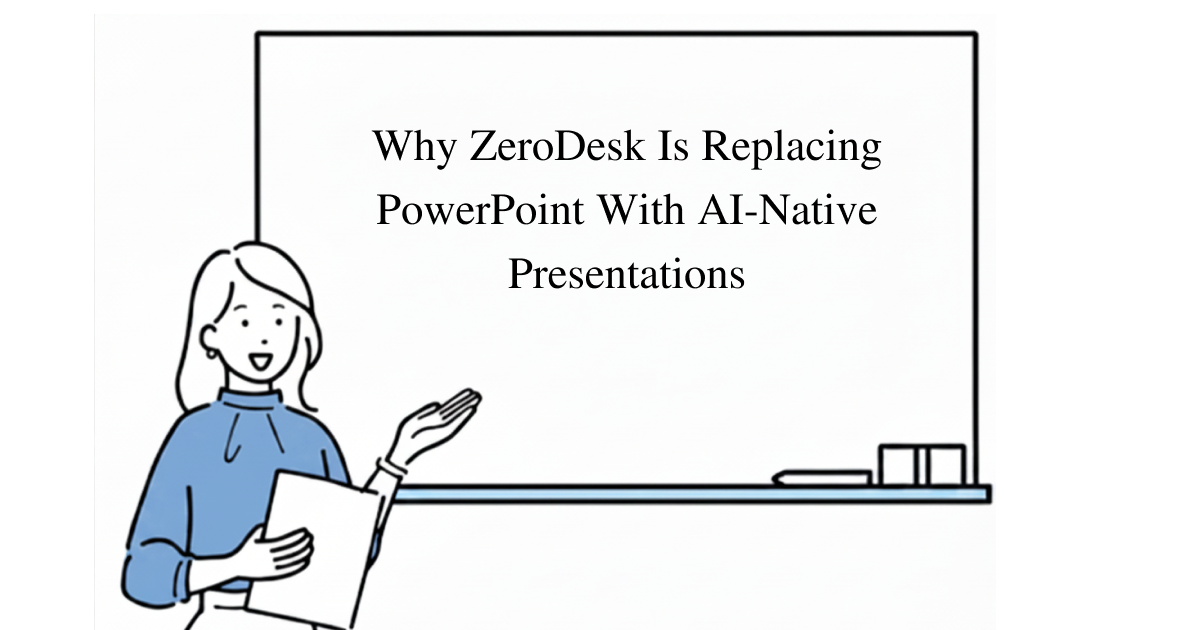
Why ZeroDesk Is Replacing PowerPoint With AI-Native Presentations
Introduction
AI slide generators are not just speeding up presentations.
They are changing how ideas get communicated at work.
For decades, PowerPoint dominated workplace communication.
PowerPoint Powered Everything
- Pitch decks
- Sales presentations
- Quarterly reviews
- Investor meetings
- Strategy reports
- Internal updates
Every serious company depended on slides.
And because there was no real alternative, employees accepted the process as normal:
- Collecting information manually
- Rewriting content repeatedly
- Formatting layouts for hours
- Searching for visuals
- Building decks slide by slide
Presentation work became one of the biggest hidden productivity drains inside modern companies.
Then AI arrived.
And suddenly people started asking a question that should have been asked years ago:
Why are humans still spending entire workdays making slides manually?
That question is exactly why AI presentation generators and AI-native workspaces are becoming one of the fastest-growing trends in enterprise productivity.
And it is also why ZeroDesk believes traditional presentation software may become obsolete much faster than most companies expect.
PowerPoint Was Built for a Pre-AI Workflow Model
The biggest problem with traditional presentation software is not design.
It's operational structure.
PowerPoint assumes humans should manually:
- Organize information
- Structure narratives
- Design slides
- Rewrite summaries
- Collect research
- Format layouts
- Coordinate content
That workflow made sense before AI systems could synthesize information instantly.
It makes far less sense now.
What Modern AI Can Already Do
- Generate presentations
- Summarize research
- Build slide structures
- Extract insights
- Create visual hierarchies
- Turn raw information into polished outputs
All within minutes.
Once teams experience that speed, the traditional slide-making process immediately starts feeling outdated.
Presentation Work Is Mostly Operational Overhead
Most professionals do not actually spend time thinking while building slides.
They spend time maintaining them.
Where Presentation Time Goes
- Fixing layouts
- Adjusting fonts
- Rewriting information
- Moving elements
- Aligning visuals
- Updating charts
- Rebuilding decks repeatedly
The majority of presentation work is operational maintenance disguised as productivity.
And AI is attacking exactly that category of work.
Why Demand Is Exploding
Searches around:
- AI presentation maker
- AI slide generator
- AI pitch deck creator
- AI PowerPoint alternative
- AI presentation software
have grown rapidly because businesses are realizing presentations should not require hours of manual production anymore.
ChatGPT and Claude Accelerated Demand for AI-Generated Presentations
The rise of ChatGPT and Claude changed how employees approach information itself.
What AI Already Improved
- Research became faster
- Summaries became instant
- Ideas became easier to structure
- Writing became dramatically more efficient
Naturally, the next expectation followed:
If AI can generate content instantly, why are presentations still being built manually?
That pressure created massive demand for AI-native presentation workflows.
Because modern teams no longer want software that simply helps create slides.
They want systems capable of turning information directly into execution-ready outputs.
Most AI Slide Tools Still Solve Only Part of the Problem
Right now, many AI presentation tools focus primarily on slide generation.
But enterprise workflows involve far more than generating visuals.
Teams still need:
- Research
- Data synthesis
- Competitive analysis
- Workflow coordination
- Context organization
- Collaborative execution
This is where AI-native workspaces begin separating themselves from standalone AI slide generators.
The Difference
Standalone AI presentation tools create slides.
AI-native workspaces connect presentations to the entire workflow.
That means:
- Research happens in the same environment
- Analysis stays connected to outputs
- Collaboration remains centralized
- Presentations are generated from active work
This dramatically reduces operational friction.
ZeroDesk Is Betting That Presentations Should Be a Byproduct of Work
Traditional presentation software treats slide creation as a separate process.
ZeroDesk is approaching it differently.
Instead of employees manually collecting information across dozens of systems to create decks, AI-native workspaces can increasingly generate presentations directly from active workflows.
What That Looks Like
- Research becomes presentation-ready automatically
- Reports become visual summaries instantly
- Meetings become structured outputs
- Workflows generate decks naturally
The presentation stops being a task.
It becomes an automatic layer of execution.
That is a very different future from manually building slides inside traditional software.
AI-Native Workspaces Threaten Another Major SaaS Category
The presentation software industry survived for years because creating polished communication required heavy manual effort.
AI changes that completely.
Once intelligent systems can:
- Research
- Write
- Structure
- Design
- Summarize
- Visualize
Inside one workspace, standalone presentation tools become far less necessary.
This is exactly why AI-native productivity platforms are becoming such a disruptive force across enterprise software.
They collapse multiple workflows into one intelligent operating environment.
And presentations are only one example of that shift.
The Future of Workplace Communication Will Be Dramatically Faster
Most companies still underestimate how much time employees lose producing internal presentations.
Hours Disappear Into
- Status decks
- Meeting summaries
- Strategy slides
- Performance reviews
- Investor reports
- Internal updates
AI-native systems are beginning to compress these workflows dramatically.
That means companies operating with AI-native workspaces will:
- Communicate faster
- Iterate faster
- Execute faster
- Reduce operational overhead
And over time, that speed difference compounds.
Why ZeroDesk Believes the Future Isn't PowerPoint
PowerPoint helped define workplace communication for decades.
But the next generation of productivity software is not focused on helping people make slides faster.
It is focused on making slide creation largely unnecessary as a separate activity.
The future belongs to systems that can transform work directly into communication.
Instead of creating presentations after the work is finished, the presentation becomes a natural output of the work itself.
That is the vision ZeroDesk is building toward.
Final Thoughts
PowerPoint defined workplace communication for decades.
But AI-native systems are beginning to redefine how communication itself gets produced.
The future is not employees spending hours formatting slides manually.
The future is intelligent systems capable of transforming workflows, research, analysis, and operations directly into polished outputs automatically.
The Future Looks Like
- Less manual slide creation
- Less formatting work
- Less operational overhead
- More automation
- More execution
- More intelligent communication
That is why ZeroDesk believes AI-generated presentations are not just another productivity feature.
They are part of a much larger shift toward AI-native execution.
And that shift may eventually make traditional presentation software feel as outdated as paper reports.