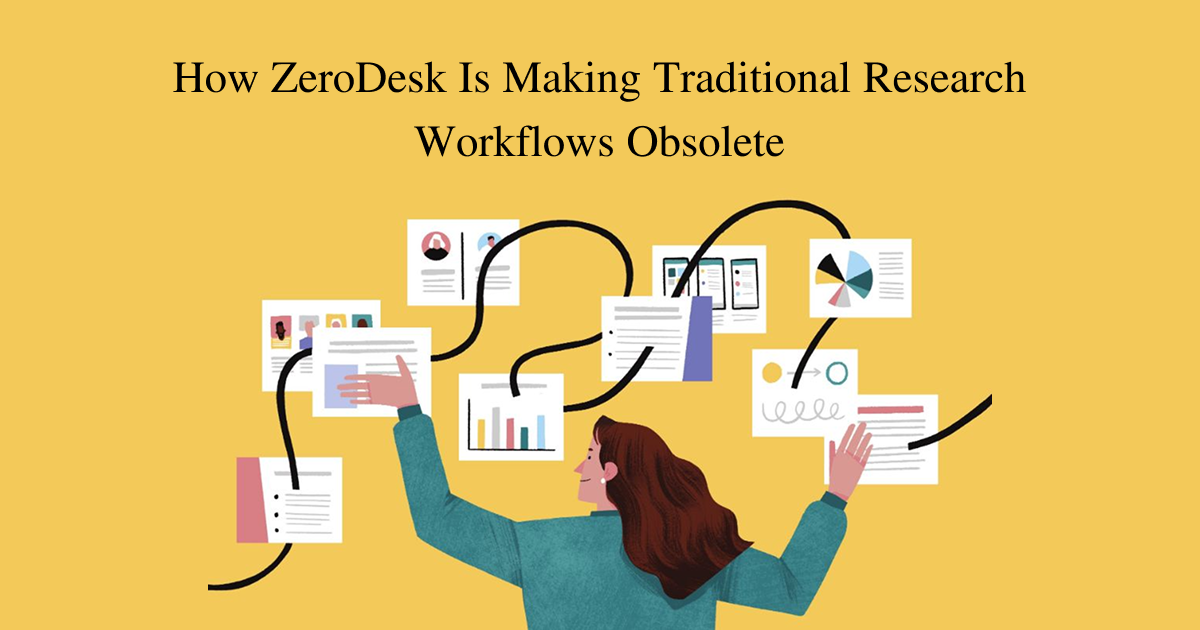
How ZeroDesk Is Making Traditional Research Workflows Obsolete
Introduction
The way most companies still do research is painfully outdated.
The Traditional Research Workflow
- Open ten tabs
- Read twenty articles
- Copy information into documents
- Summarize findings manually
- Compare competitors
- Search for market insights
- Rewrite notes
- Build reports from scratch
For years, businesses accepted this workflow as normal.
Research was supposed to be slow.
Then AI changed everything.
ChatGPT accelerated information access.
Claude improved long-context reasoning.
DeepSeek pushed intelligent analysis further.
AI agents started conducting multi-step workflows autonomously.
And suddenly the biggest question became impossible to ignore:
Why are humans still spending entire workdays manually collecting information that AI can process in minutes?
That question is exactly why ZeroDesk believes traditional research workflows are becoming obsolete.
Most Research Work Is Repetitive Operational Labor
Companies often treat research like high-value strategic work.
But the reality is that a large percentage of research time is spent on repetitive operational tasks.
Where Research Time Actually Goes
- Opening tabs
- Comparing sources
- Rewriting summaries
- Organizing notes
- Copy-pasting information
- Collecting screenshots
- Structuring findings
Very little of the process actually requires deep thinking.
Most of it requires coordination.
And coordination is exactly the type of work AI systems are starting to eliminate.
Why AI Research Demand Is Growing
Searches around:
- AI research tools
- AI research automation
- AI-powered research
- Parallel AI research
- AI competitive analysis
- AI market research
continue growing because businesses are realizing research should not consume entire teams anymore.
ChatGPT and Claude Changed Expectations Around Information Access
Before AI, research bottlenecks were accepted as part of work.
Employees spent hours gathering context before decisions could even begin.
Then ChatGPT and Claude changed expectations completely.
What AI Can Already Do
- Summarize articles instantly
- Compare information rapidly
- Extract insights quickly
- Analyze documents at scale
- Synthesize large amounts of context
Once teams experienced that speed, traditional research workflows immediately started feeling inefficient.
And naturally, the next question followed:
If AI can process information this fast, why are humans still manually stitching research together?
That question is now reshaping enterprise productivity.
Most Companies Still Research Like It's 2018
Despite all the excitement around AI, many organizations still rely on deeply manual research processes.
Teams continue:
- Switching between tabs
- Searching fragmented systems
- Rewriting findings repeatedly
- Managing spreadsheets manually
- Building reports from scratch
The tools became more modern.
The workflows did not.
This is the same structural problem happening across many productivity categories today.
AI was added to old systems.
But the operational model underneath remained fragmented.
That is why many teams still feel overwhelmed despite adopting multiple AI tools.
ZeroDesk Is Betting on Parallel AI-Native Research
Traditional research workflows happen sequentially.
Humans search one source at a time.
Analyze one document at a time.
Compare findings manually.
Organize information themselves.
AI-native systems change that model completely.
What AI-Native Research Looks Like
Instead of conducting fragmented research manually, intelligent workspaces can increasingly:
- Analyze multiple sources simultaneously
- Synthesize insights automatically
- Compare competitors instantly
- Organize findings in real time
- Generate structured outputs automatically
That creates something far more powerful than AI-assisted research.
It creates AI-native research execution.
And operationally, the difference is massive.
Research Teams Are About to Become Dramatically More Efficient
One of the biggest implications of AI-native productivity systems is the reduction of operational research overhead.
Historically, information processing required significant human coordination.
AI changes that.
Work That Can Be Automated
A single intelligent workspace can increasingly perform workflows that previously required:
- Analysts
- Research associates
- Strategy teams
- Operations staff
- Manual reporting layers
This does not mean human strategy disappears.
It means operational research work shrinks dramatically.
The companies that understand this shift early will move significantly faster than competitors still dependent on manual information gathering.
ZeroDesk Connects Research Directly to Execution
This is where ZeroDesk positions itself differently from standalone AI assistants.
Most AI tools stop at generating information.
Humans still need to:
- Organize outputs
- Coordinate workflows
- Build presentations
- Manage execution
- Share findings manually
ZeroDesk is designed to collapse those layers together.
Research Becomes Connected To
- Presentations
- Workflow automation
- Execution systems
- Collaboration
- Decision-making
All inside one integrated environment.
That dramatically reduces operational friction.
And over time, it may fundamentally change how companies make decisions.
The Future of Enterprise Research Is Autonomous
The biggest misconception about AI research tools is that they only make research faster.
The real shift is much larger.
AI-native systems are beginning to transform:
The Entire Research Lifecycle
- How information gets collected
- How insights are synthesized
- How workflows are coordinated
- How decisions move into execution
Research itself is becoming increasingly autonomous.
And companies still relying heavily on manual information gathering may eventually find themselves operating at a significant disadvantage.
Why ZeroDesk Believes Research Is Becoming an AI-Native Function
Research has historically been separated from execution.
Teams gather information first.
Then they analyze it.
Then they build reports.
Then they present findings.
Then they decide what to do.
AI-native systems compress that entire chain.
Instead of research being a standalone activity, it becomes part of a continuous workflow that moves seamlessly from information gathering to action.
That is the future ZeroDesk is building toward.
Final Thoughts
Traditional research workflows were built for a world where humans had to manually process information at scale.
That world is disappearing quickly.
What Changed
- ChatGPT accelerated information access
- Claude improved reasoning
- AI agents introduced autonomous workflows
- AI-native workspaces are connecting research directly to execution
The future is not just faster research.
The future is dramatically less manual research.
Less fragmentation.
Less coordination.
More intelligence.
More automation.
More execution.
That is why ZeroDesk believes the next generation of enterprise research will not be defined by who can gather information fastest.
It will be defined by who can turn information into action most efficiently.