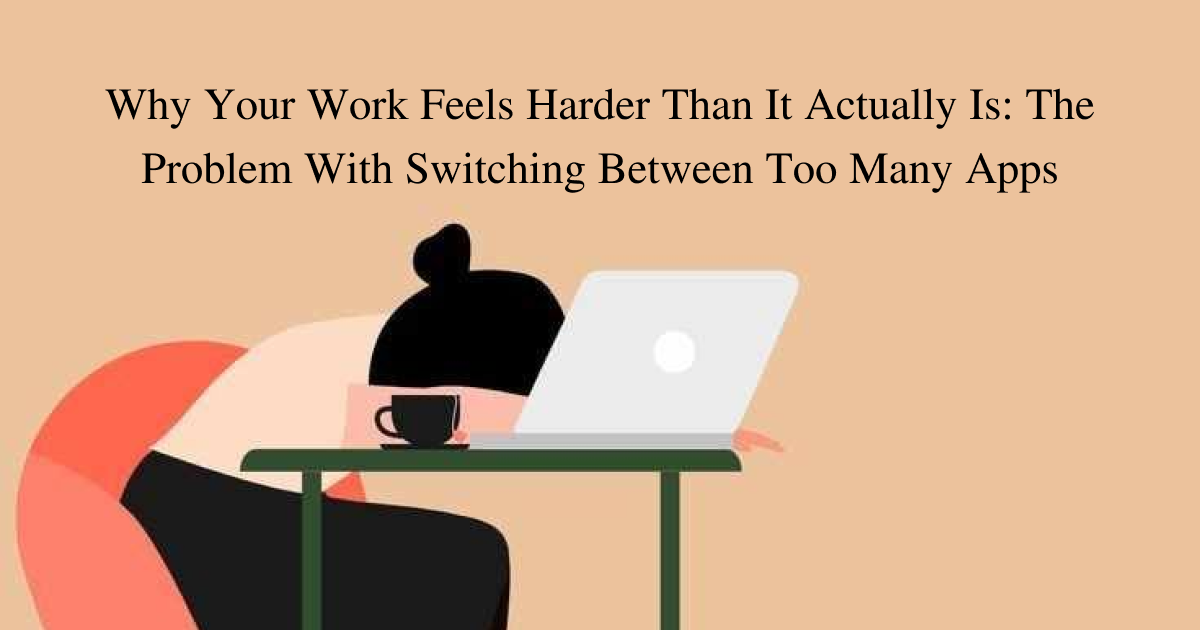
Why Your Work Feels Harder Than It Actually Is: The Problem With Switching Between Too Many Apps
Sometimes, the work itself isn't the problem.
It's everything around it.
You sit down to complete a project and start with a simple task. Maybe you need to research a topic, prepare a presentation, work on a campaign, or finish an assignment.
Then the switching begins.
You open one app to search for information.
Another to ask AI for help.
A document to write down your ideas.
A separate tool to manage tasks.
Another tab for your files.
Before you've made any real progress, you're already jumping between five different places.
The actual work may not be difficult, but managing where everything lives can make it feel much harder than it needs to be.
The Hidden Cost of Switching Between Apps
Most of us don't think twice about switching between tools.
It's become normal.
Research in one place.
Notes somewhere else.
Files in another folder.
Tasks in a separate app.
AI conversations in yet another tab.
Each switch may only take a few seconds, but the bigger problem is losing context.
You stop writing to search for a file.
You leave your research to update a task.
You ask AI a question, then have to copy the response somewhere else.
By the time you return to what you were originally doing, you've already broken your flow.
The more often this happens, the harder it becomes to stay focused.
Your Work Is Connected. Your Tools Usually Aren't.
Think about how a typical project actually works.
You start with an idea.
That idea leads to research.
The research turns into notes.
The notes become a document, presentation, campaign, or plan.
Then there are tasks to manage, files to organise, and changes to review.
Everything is connected.
But when every part of the process happens in a different tool, you have to create those connections yourself.
You're constantly moving information from one place to another.
Copying.
Pasting.
Downloading.
Uploading.
Searching.
Trying to remember where you saved something.
The work becomes fragmented, even though the project itself isn't.
More Apps Don't Always Mean More Productivity
When there's a new problem, the usual solution is to download another app.
Need to take notes? Get a note-taking app.
Need to manage tasks? Get a task manager.
Need AI? Open a chatbot.
Need to store files? Use cloud storage.
Need to collaborate? Add another platform.
Eventually, you have a collection of useful tools that don't necessarily work together.
The problem isn't that these tools are bad.
Most of them are great at what they do.
The problem is that you become responsible for connecting them all.
And that can create more work instead of reducing it.
Why Context Matters
Imagine you're working on a marketing campaign.
You have a brand brief, research documents, campaign ideas, competitor information, and a list of tasks.
Now imagine asking an AI tool for help.
If the AI understands the information you're already working with, you can continue from where you are.
You don't have to repeatedly explain the project from scratch or manually move information between different tools.
That's where a connected workspace becomes useful.
Your files, research, ideas, and tasks aren't separate parts of your work anymore. They can exist within the same workflow.
One Workspace Can Make Work Feel Simpler
This is the idea behind ZeroDesk.
Instead of treating AI, files, research, and tasks as completely separate parts of your day, ZeroDesk brings them together in one workspace.
You can move from an idea to research, from research to execution, and from execution to managing what needs to happen next without constantly losing context.
For example, you might:
- Add your files to a workspace
- Research and analyse information
- Ask AI questions based on your work
- Develop ideas and documents
- Organise tasks and next steps
Instead of constantly asking, "Where was that file?" or "Which tab did I have open?", more of your work stays connected.
Less Switching, More Focus
The goal isn't to eliminate every tool you use.
It's to reduce unnecessary switching.
You may still have specialised tools for certain tasks. But your main workflow doesn't have to be scattered across multiple platforms.
When your work is organised and connected, it's easier to pick up where you left off.
You spend less time searching.
Less time copying information.
Less time reopening tabs.
And more time actually doing the work.
The Real Productivity Problem Isn't Always Time
When people feel unproductive, they often assume they need to work faster.
But sometimes the issue isn't speed.
It's friction.
Every unnecessary step creates friction.
Searching for files.
Switching tabs.
Explaining the same context again.
Moving information between apps.
These small interruptions can make even a simple task feel overwhelming.
Removing some of that friction can make your workflow feel much easier without requiring you to work longer or harder.
Final Thoughts
Your work may feel difficult not because there's too much to do, but because there's too much to manage.
Ideas are in one place.
Files are in another.
Research is somewhere else.
Tasks live in a separate app.
AI is open in another tab.
When everything is disconnected, staying focused becomes harder than it needs to be.
A connected AI workspace like ZeroDesk helps bring those parts of your workflow closer together.
Because sometimes, getting more done isn't about adding another tool.
It's about finally having a place where your work can come together.