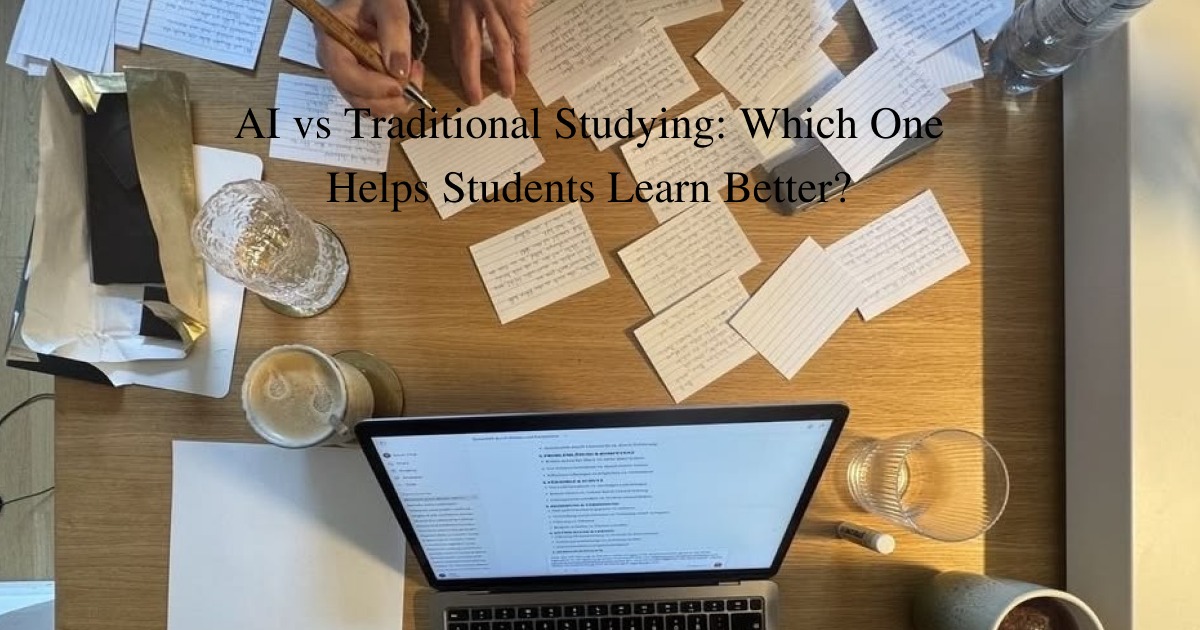
AI vs Traditional Studying: Which One Helps Students Learn Better?
Every new technology brings the same debate.
Calculators were once considered unfair.
The internet was seen as a distraction.
Online classes were questioned.
Now it's AI.
Some students believe AI is making learning easier. Others think it's making students dependent. The truth lies somewhere in between.
The question isn't whether AI is good or bad.
The real question is whether you're using it in the right way.
Traditional Studying Still Has Its Place
There's no replacement for understanding a subject.
Reading textbooks, attending lectures, solving practice questions, and discussing concepts with classmates are still some of the best ways to learn.
These methods help you build critical thinking, improve problem-solving skills, and prepare for real-world situations where memorized answers aren't enough.
AI shouldn't replace these habits.
It should support them.
Where Traditional Studying Falls Short
The biggest challenge students face today isn't a lack of resources.
It's information overload.
For one assignment, you might have:
- Five research papers
- Three lecture PDFs
- Multiple websites
- Class notes
- Recorded lectures
- Presentation slides
Before you even begin studying, you've already spent a significant amount of time collecting information.
This is where AI becomes useful.
Where AI Makes the Biggest Difference
Instead of replacing learning, AI removes repetitive tasks that don't add much value.
Students can use AI to:
- Summarize long chapters
- Explain difficult concepts
- Organize study material
- Generate revision questions
- Create study plans
- Simplify technical language
The time you save can then be spent understanding concepts instead of searching for information.
AI Doesn't Know Your Professor
One mistake many students make is assuming AI knows exactly what their professor expects.
It doesn't.
Every university follows a different syllabus.
Every professor has different expectations.
Every assignment has different requirements.
That's why AI should be treated as an assistant, not the final authority.
Always compare AI-generated information with your class notes, textbooks, and assignment guidelines.
The Best Approach Is a Combination of Both
Instead of choosing between AI and traditional studying, combine them.
For example:
-
Attend the lecture and understand the topic.
-
Use AI to simplify concepts you didn't understand.
-
Read your textbook for detailed explanations.
-
Use AI to summarize your notes before revision.
-
Test yourself using practice questions.
This approach gives you the best of both worlds.
Keep Your Study Material Organized
Another challenge students face is keeping track of everything.
Research is in one folder.
Assignments are somewhere else.
Lecture notes are scattered across different apps.
By the time exams arrive, finding your own material becomes difficult.
An AI workspace like ZeroDesk helps solve this by keeping research, notes, assignments, documents, and AI together in one place. Instead of constantly switching between apps, students can focus on studying while everything stays organized.
Final Thoughts
AI isn't replacing education.
It's changing the way students prepare, research, and organize their work.
The students who benefit the most from AI aren't looking for shortcuts. They're using it to remove unnecessary work, stay organized, and spend more time learning.
Traditional studying builds knowledge.
AI improves the process.
When used together, they create a much more effective way to learn.